Guides
Local Search Ranking Factors: What Google Confirms
Google ranks local results on three factors: relevance (how well a profile matches the search), distance (how far the business is from the searcher) and prominence (how well-known it is, including reviews and links).
By SEORecheck Research Team, SEO auditorsPublished 9 min read
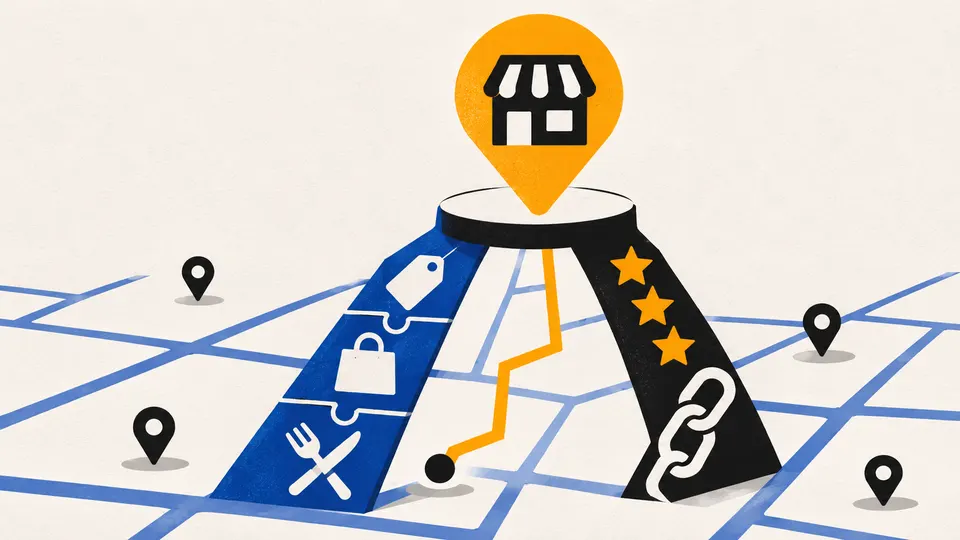
Google names three local search ranking factors: relevance (how well your Business Profile matches the search), distance (how far you are from the searcher) and prominence (how well-known your business is). Reviews, links, complete profile data and your normal web rankings feed these factors. Paying Google won't move you up, and nothing else will either.
What follows separates what Google documents from what local SEO practitioners believe. It also sorts the factors into ones you control, ones you can influence and ones you can't touch.
What are local search ranking factors?
Local search ranking factors are the signals Google uses to decide which businesses appear, and in what order, for searches with local intent: the map pack, Google Maps and the local-flavoured organic results below them. Google sums them up in three words: relevance, distance and prominence.
Google's own help page, How to improve your local ranking on Google, defines each one:
- Relevance: "how well a Business Profile matches what someone is searching for."
- Distance: "how far each business is from the customer who's searching." If the searcher doesn't share a location, "Google uses what it knows about their location."
- Prominence: "how well-known a business is." The page names links to your business and the number of reviews as inputs, and says "more reviews and positive ratings can help your business's local ranking."
The same page also says: "There's no way to request or pay for a better local ranking on Google." Map ads exist, but they're labelled as ads and don't change the organic local order.
Location affects ordinary search too. Google's How Search ranks results page explains that a search for "pizza" brings up nearby businesses because the system spots local intent.
How does Google rank businesses in the map pack?
Google first works out whether the query has local intent. Then it picks profiles that match the query (relevance), weights them by how close they are to the searcher or the place named in the query (distance), and orders them by how well-known and well-reviewed they are (prominence). A complete, accurate profile helps with all three.
In practice the three factors trade off against each other. Google's help page says that a business farther away may still rank above a closer one if it's more likely to have what the searcher wants. So distance is a strong starting point, but it isn't the final word.
Here's how each factor turns into things you can work on:
| Factor | What Google says | Signals you can influence | How much you control it |
|---|---|---|---|
| Relevance | Profile matches the search | Primary and secondary categories, services, description, attributes, matching website pages | High |
| Distance | Distance from searcher or named location | Real address, accurate pin, service-area settings | Very low (you can only make it accurate) |
| Prominence | How well-known the business is | Review count and rating, links, mentions in articles and directories, organic rankings of your site | Medium, over months |
| Completeness | "Complete and accurate info" shows up more often | Hours, special hours, phone, website, photos, verification | High |
Which local ranking factors does Google confirm?
Google confirms a short list: complete and accurate profile information, verification, correct hours (special hours included), photos, reviews and your responses to them, links and other signs that your business is well-known, and how your site performs in regular web results. Anything beyond that is educated guesswork from the industry, not documentation.
Put together from Google's local ranking page, the documented items are:
- Complete and accurate information. "Businesses with complete and accurate info are more likely to show up in local search results." That means a full address, hours, categories and attributes.
- Verification. It "tells Google that you're authorized to represent the business."
- Hours, including special hours. These help customers know when they can visit.
- Photos and videos that show what you offer.
- Reviews and review responses. More reviews and higher ratings help prominence.
- Links and web presence. The number of websites linking to you counts toward prominence.
The field-by-field setup is covered in our Google Business Profile optimization guide. This article stays on why these fields matter for ranking.
What do local SEO experts think matters most?
The best-known outside source is Whitespark's 2026 Local Search Ranking Factors report. In it, 47 local search experts scored 187 factors. Their top five map pack factors were the primary Business Profile category, proximity to the searcher, keywords in the business name, a physical address in the city of the search, and being open at the time of the search.
Keep in mind that this is a survey of opinion. The report itself says: "None of the experts have special access to the internal workings of Google's local search algorithm." Treat it as a well-informed list of what practitioners see working, not as a measured algorithm.
Three points from the 2026 edition are worth knowing:
- Review signals and behavioural signals rose in importance compared with earlier editions, by the report's own account.
- "Open at the time of search" placed in the top five. That gives you another reason to keep regular and holiday hours accurate.
- The report added an AI visibility score for every factor, and noted that citations (consistent mentions of your business across directories) matter again for AI answers.
Keywords in the business name: the factor you shouldn't "use"
Keywords in the business name rank near the top of the survey, but Google's Business Profile guidelines ban adding unnecessary information to the name. The guidelines warn that doing so "could result in the suspension of your Business Profile." If your real, signed name already contains "Plumbing", fine. If it doesn't, adding the word to the profile name is a policy violation, not an optimization. Competitors who stuff keywords into their names can be reported with a suggested edit.
Which factors can a small business actually change?
You control your categories, profile completeness, hours, photos, website pages and how you ask for reviews. Over months you can influence prominence through reviews, local links and press mentions. You can't change where searchers are standing, and faking your location (virtual offices, P.O. boxes) breaks Google's guidelines.
A practical order of work:
- Get the primary category right. Google's guidelines say to pick the fewest categories that describe your core business, using "IS A" logic: you are a "Dentist", not "Teeth whitening near downtown". Add secondary categories only for real lines of business.
- Make the profile complete and true. Address or service area, phone, website, regular and special hours, attributes, photos. Service-area businesses without a storefront should hide the address. Their service area shouldn't extend beyond about two hours' drive from the base, according to the guidelines.
- Back the profile up on your website. Build one page per core service and, if you have several locations, one page per location. Show the same name, address and phone (NAP) everywhere and link the profile to the right page.
- Earn reviews steadily. Ask every customer, reply to reviews, and never pay for them or filter who you ask (see the next section).
- Build local prominence. Get listed in local chambers, industry associations, local news coverage and sponsorships. These give you real links and mentions, which Google names as prominence inputs.
- Keep the website technically healthy. Google says your position in web results counts toward local prominence, so crawl, indexing and speed problems on your site hold back the profile too.
Example. Take a two-chair physiotherapy clinic that ranks fourth in the map pack for "physiotherapist" across town. Its primary category is "Medical clinic", its holiday hours are missing and its website has only a single "Services" page. Switching to the more specific category, adding the hours and publishing separate pages for sports injury and back pain treatment covers relevance and completeness right away. Prominence (reviews, local links) is slower work that runs alongside.
How do reviews affect local rankings?
Google says more reviews and positive ratings can help your local ranking, and that replying to reviews shows customers you value them. The quantity, rating and steady flow of real reviews all count, but only reviews collected within Google's policies. Fake, paid or filtered reviews risk removal and penalties.
Google's Maps user-contributed content policy is explicit. Businesses may not:
- offer "payment, discounts, free goods and/or services" in exchange for any review;
- "discourage or prohibit negative reviews, or selectively solicit positive reviews". This is review gating, where you send only happy customers to Google;
- post content that is "not based on a real experience".
A sound review routine looks like this: send a short link after every completed job, reply to every review within a few days (negative ones especially, calmly and with specifics), and mention the service and area in your reply only where it reads naturally. Don't chase a target number. A steady stream of reviews looks more natural than a sudden burst.
Does your website still matter for local rankings?
Yes. Google lists your position in web results as part of prominence, and your website is where relevance gets confirmed: the services, areas and facts on your pages should match the profile. A thin one-page site gives Google, and AI assistants, little to match against a specific search like "emergency boiler repair in Leeds".
What to check on the site:
- Service and location pages with real, specific content, not near-identical city pages with the town name swapped. Those can count as doorway pages.
- Consistent NAP in the footer or on the contact page, matching the profile character for character where you can.
- LocalBusiness structured data. Google's LocalBusiness documentation requires
nameandaddressand recommends hours, geo coordinates, phone and URL. Google presents it as a way to show business details in search results, not as a ranking boost, and doesn't guarantee that the features will appear. - Technical basics: indexable pages, a working mobile version, decent Core Web Vitals and no
noindexleft on location pages.
A minimal example:
{
  "@context": "https://schema.org",
  "@type": "Dentist",
  "name": "Riverside Dental",
  "address": {
    "@type": "PostalAddress",
    "streetAddress": "12 Mill Lane",
    "addressLocality": "York",
    "postalCode": "YO1 7AA",
    "addressCountry": "GB"
  },
  "telephone": "+44 1904 000000",
  "url": "https://example.com/york/",
  "openingHours": "Mo-Fr 08:30-17:30"
}
Our local SEO audit checklist walks through these site-side checks in order. If you want to see where your own site stands, the free SEORecheck audit flags missing or invalid LocalBusiness markup, inconsistent contact details and indexing problems on your location pages, with example URLs.
Do local ranking factors affect AI search results?
Partly. When AI assistants answer "best dentist near me", they rely on search indexes, business listings and what the web says about you, so accurate profiles, consistent facts and real reviews help there too. No AI platform publishes a list of local ranking factors, so any "AI local ranking factor" list is opinion.
What you can do is make your facts easy to verify: a matching Bing Places listing, consistent NAP across directories, crawlable service pages and Organization or LocalBusiness markup. Our guide to AI search optimization for local businesses covers the platform-specific steps.
Key takeaways
- Google confirms three local ranking factors: relevance, distance and prominence. Nobody can pay for a better position.
- Documented inputs include complete and accurate profile data, verification, hours, photos, reviews, links and your site's organic performance.
- Expert surveys such as Whitespark's rank the primary category, proximity, business name, a local address and open hours highest. They're informed opinion, not Google documentation.
- Keyword-stuffed names, fake addresses, incentivized reviews and review gating break Google's policies and can get a profile suspended or reviews removed.
- Your website still matters: it confirms relevance and feeds prominence, so service pages, consistent NAP and technical health are part of local SEO.
- To see how findings like these are laid out with affected URLs, look at the sample report.